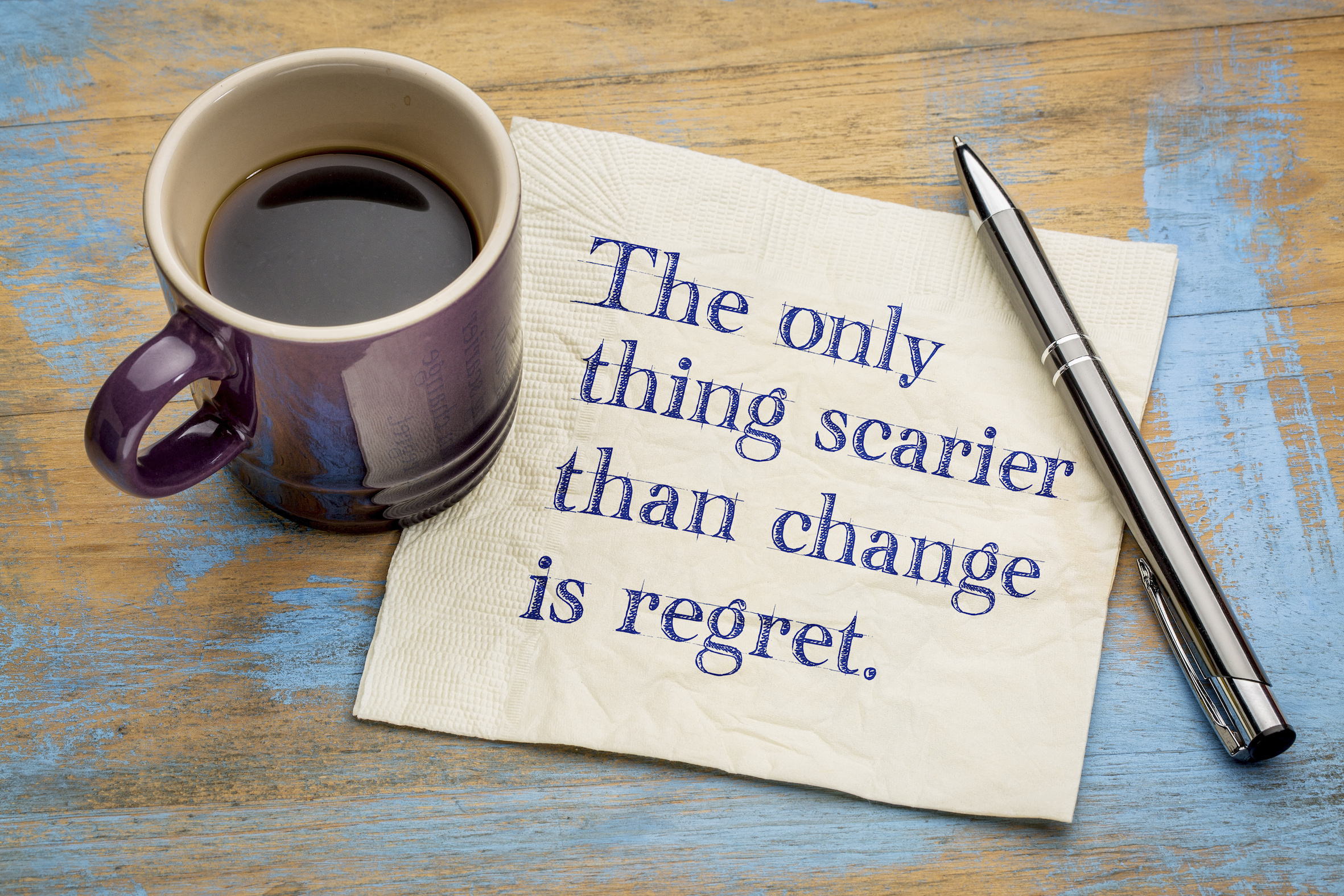
When I first started thinking about leaving the corporate world, I was terrified. I had grown up in a family of entrepreneurs, but personally, corporate jobs were all I had known. And despite the challenges – the stress, the long hours, the extensive travel – those jobs had provided 20-plus years of benefits and a good, steady income.
The more I thought about it, however, the more I realized I was even more terrified of looking back at age 65 and asking myself, “What if?” If I stayed in the corporate world, would I have regrets? Would I wish that I had taken the risk? Would I feel like I’d missed out on the chance to maximize financial wellbeing and my legacy?
To help me make a decision, I decided to ask myself seven hard questions, and answer honestly. These weren’t questions about franchise brands, my business skills, or investment ranges. They were about regret, and how I could avoid it.
Question #1: If I stay, will I own anything I’ve built?
At the time, I expected to spend about 10 more years working full-time. So I asked myself, “If I spend that entire time in the corporate world, what will I be building, and for whom?” Building is my natural bent as an executive, whether that means building people, building divisions, or building brands. I knew that, given the opportunity, I could build quite a lot in 10 years.
However, when I was honest with myself, I knew I wouldn’t own any of it.
Everything I might build over the next decade would belong not to me, but to the company where I worked. It might earn me a nice bonus each year, but the intellectual property and nearly all the profits would go to my employer.
Question #2: Do I want to trade time for money, or for equity?
There’s a famous scene in the TV show Mad Men where Peggy complains to her boss, Don Draper, that she provides him with a constant flow of great ideas, and he never thanks her for them or gives her a sense of ownership in the ad agency where they work. Without missing a beat, he says, “That’s what the money is for!”
That’s a typical mindset in a corporate environment: “Your check clears every month, right? You should take it and be grateful for it. What more could you possibly want?”
But I did want more. I wanted a sense of ownership, and to see my financial reward grow in proportion to the growth I created. I didn’t want to just trade away my life for a paycheck.
Question #3: Is my fear protecting me or trapping me?
We evolved a fear response for a reason. When our prehistoric ancestors encountered new animals or environments, their lack of knowledge about the situation could literally – and sometimes instantaneously – mean the difference between life and death.
Fear can still sometimes alert us to legitimate dangers, but in modern life, new situations are typically not life-or-death. It’s important to realize that our primal fear response is still just as strong, but we need to employ our rational brains to assess whether it’s proportional.
When I stopped to examine my situation, I realized that my fear was not protecting me from legitimate threats. My wife Lauri and I had the resources to cushion our family during a transition period. Fear was actually holding me back, trapping me in an arrangement that wasn’t to my family’s benefit.
Question #4: What’s the worst that happens if I try? If I don’t?
This one was a real eye-opener when I let myself really think about it. On the one hand, I realized that leaving the corporate world didn’t involve the big scary risks I assumed it would, especially since my wife Lauri and I had a sensible plan for buffering ourselves financially. I could take a lower-pressure, full-time job and launch the new business as a side hustle. Lauri, who had covered home base while I worked long hours and traveled as an executive, could return to full-time employment. And we were actually excited about the freedom we could gain by downsizing our home.
But if I didn’t try a new path? That was actually where the scary risks were. Worn down by decades of high-stress work, I’d recently had a serious health event that almost killed me. And I was tired of the way my career kept me away from my family. Thankfully, they had shown tremendous grace and were still hanging in there with me, but I worried about permanent damage to those relationships. My marriage, my connection with my kids, and even my life could be on the line if I didn’t change gears.
Question #5: Who’s going to control my calendar for the next decade?
The question of time was another big consideration for me. As an executive, I traveled constantly. I missed family dinners, milestones, and vacations. Even when I was supposedly taking time off, I was still working. “Just a few” emails at breakfast. Ducking out of dinner to take a call. Staying behind at the cabin or hotel because I had to finish a slide deck. Especially since my health event, I was keenly aware that I would never get back that time.
If I struck out on my own, however, I could do better. Yes, I would need to work for another employer for a few years while my business launched. But I could find a job that was less demanding, and my family could finally put down roots somewhere. Then, when those few years were up, I would have complete ownership of my schedule. I could spend true quality time with my wife, kids, and extended family. Take real vacations. Manage my health. Enjoy my hobbies. That was a very big draw.
Question #6: If I’m going to work this hard, shouldn’t I keep what I create?
This thought took me back to questions 1 and 2, but from a slightly different perspective. I did realize that becoming a franchisee wouldn’t allow me to go from 100 to 0 in a month. I knew that launching the business would be hard work at first. I would have to juggle a side hustle with a full-time job, and Lauri would be working full-time as well.
But at the end of that period? The return from my time and financial investment would belong to me. I would only need to consult with Lauri to decide what to do with it. We could hold onto the business for a while and enjoy the cashflow from it, or sell it and reap a windfall.
Question #7: Will I respect the person I see in the mirror at 65?
When I thought about leaving the corporate world, this question cut deepest. For many years, I had told myself and others that my family were the most important thing in my life. But had I really lived that? Was my work in the corporate world building the kind of legacy I wanted to leave, financially or personally? I also thought about the other things I valued: staying healthy, building new things, exploring, my community.
When I got to 65, I wanted to feel that I’d done everything I could to elevate those priorities. And I couldn’t honestly say that would be the case if I stayed in the corporate world. In order to live my values, I needed ownership. Empowerment. Freedom. And I wasn’t going to get those by continuing to work long hours and degrading my health, or by pouring my time into a role that didn’t reward me in proportion to my effort.
The Final Answer
As I thought through these questions, here’s what I realized: When you’re a corporate employee, fear happens to you. It comes from things you can’t control. Layoffs, reorgs, a new CEO who doesn’t even know your name. You have to just absorb it.
I knew that, as a franchisee, I would still experience fear. But I would be able to do something about it. I could validate numbers and talk to other franchisees who’d walked the path before me. If challenges came, I could solve them without a whole board and C-suite looking over my shoulder and trying to redirect me. I could act – and grow – in my full capacity as an experienced leader and builder.
One type of fear, I realized, would keep me up at night with no solution. The other type might keep me up at night, but with a plan. I didn’t have to be fearless. I just needed to understand that staying was scarier than leaving.
If you’re wrestling with some of the same fears, or asking yourself these questions, I’m here to help you navigate the waters. I won’t call them uncharted, because I’ve actually sailed them myself. Let me put that experience to work for you – for free! – and help you take the first step toward a better future for yourself and your family.
Comments are closed